WASHINGTON — During a Senate Judiciary Subcommittee on Antitrust, Competition Policy, and Consumer Rights oversight hearing, U.S. Senator Eric Schmitt (R-MO) questioned Netflix Co-Chief Executive Officer Ted Sarandos about his company’s overwhelmingly woke content and to examine the anti-competitive impacts of the proposed Netflix-Warner Brothers merger.
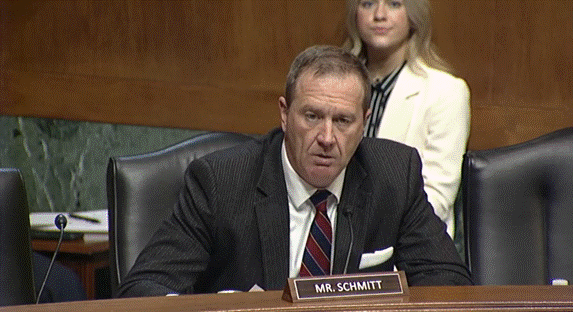
Watch Senator Schmitt full line of questioning HERE.
Transcript of Senator Schmitt’s line of questioning, lightly edited for length and clarity:
Senator Schmitt: “Thank you, Mr. Chairman. Mr. Sarandos, you are currently the CO-CEO Netflix. Is that correct?”
Ted Sarandos, Co-CEO of Netflix: “That’s correct, sir.”
Senator Schmitt: “Okay, and until recently, you were the Chief Content Officer. Is that correct?”
Mr. Sarandos: “It’s been a couple of years now but yes.”
Senator Schmitt: “Do you think network Netflix is a powerful company?”
Mr. Sarandos: “We’re a successful company.”
Senator Schmitt: “I think it’s pretty powerful. That’s probably why we’re here today right? To judge whether or not [the merger] becomes anti-competitive in some particular way, because of the power that [Netflix] wields. You said a moment ago that Netflix does not have a political agenda. Do you think Netflix is a politically biased company?”
Mr. Sarandos: “No, sir, I do not.”
Senator Schmitt: “Okay. What percentage of donations from Netflix employees and other folks affiliated with Netflix go to Republicans versus Democrats?”
Mr. Sarandos: “I saw a number of published a while ago. It’s very high Democrat.”
Senator Schmitt: “Like 99 percent?”
Mr. Sarandos: “Could be, yeah.”
Senator Schmitt: “That seems pretty high. Do you think that indicates any kind of bias by the company?”
Mr. Sarandos: “Sir, Netflix doesn’t have a political giving arm. We don’t have an active PAC. We don’t influence our employees to do anything. And our employees can support issues and candidates at their will.”
Senator Schmitt: “Okay. On June 20, 2020, on its X page, Netflix posted a video titled ‘to my white friends, guilt, shame, embarrassment’ and saying, ‘we need to do everything in our power to amplify that message.’ You stand by that statement?”
Mr. Sarandos: “I have no recall of that statement at all.”
Senator Schmitt: “I just read it to you. Do you have an opinion about it?”
Mr. Sarandos: “I don’t have any idea what context is in or anything else.”
Senator Schmitt: “In the wake of the George Floyd riots on June 20, Netflix posted on its page ‘to my white friends, guilt, shame, embarrassment’. What does that mean?”
Mr. Sarandos: “I think that is an uncharacteristic post and I’m deeply regretful that got posted.”
Senator Schmitt: “Well, it did. Netflix also said on May 30, ‘to be silent is to be complicit.’ […] So, you don’t stand by that statement then?”
Mr. Sarandos: “As I said, sir, we have no political agenda. Posting something like that would be quite political.”
Senator Schmitt: “I would agree.”
Mr. Sarandos: “And I would say what we would hope that wouldn’t happen again.”
Senator Schmitt: “Netflix also said on June 10, 2020, that to implement the Black Lives Matter agenda, Netflix understood, ‘that our commitment to true systemic change will take time.’ Do you still think that takes time? Are you still actively engaged in this effort again?”
Mr. Sarandos: “Again sir, we’re not engaged in political efforts like that.”
Senator Schmitt: “Any longer. You were, but [now] you’re not.”
Mr. Sarandos: “Again, I can’t think of a period of time, okay, I think of the time you’re talking about was a quite a volatile time for many.”
Senator Schmitt: “I think a lot of people said things that they regret. I’m just trying to figure out if they actually regret it or not. I’m not going to get into your quotes on DEI, but it seems that both you and Netflix both have made a habit of promoting DEI and wokeness. I’ll just give a few examples. Netflix content is synonymous for the modern phenomenon of race swapping both historical and real and fictional characters. Just a few examples. Netflix made black Vikings. Netflix changed Cleopatra from Macedonian to black. Achilles change from Greek to black. […] Yes or no — does Netflix stand by its content production decisions?”
Mr. Sarandos: “Senator Schmitt, we have a great deal of programming on Netflix for the left, right and center. We have state of the art tools for parents to manage what their kids see on Netflix. You could block anything. […] And the larger point, sir, is that of all the American values that we all share — and I understand parenthood is hard. I understand it’s a difficult world that we all navigate. The one we value a lot is the First Amendment. A lot of that is freedom of speech—”
Senator Schmitt: “I get it.”
Mr. Sarandos: “I want to do is give creators a place to tell their stories—”
Senator Schmitt: “I have no problem with a wide variety of content. That’s not the issue. This is America. But I guess the point I’m making is that your company has made overtly political statements. Has moved an agenda of DEI — Susan Rice was on your board, the founder of sort of Barack Obama’s DEI agenda. 99 percent of your employees contribute to Democrats to the tune of hundreds of millions of dollars. You’re engaged in this very woke programming. You do have some other options, but overwhelmingly, [it’s woke]. So, the question before this committee, you come before Congress, why in the world would we give a seal of approval or a thumbs up to make you the largest behemoth on the planet related to content? It seems as though you have engaged in creating not only a monopoly of content potentially, but the wokest content in the history of the world. So, forgive me if I’m a little concerned, not only as a parent, but also as somebody that believes that we ought to have a wide variety of content options. There are some, but the overwhelming majority of your stuff right now is overwhelmingly woke, and it’s not reflective of what the American people want to see.”
Mr. Sarandos: “Sir, respectfully, if you ask a Netflix member today or consumer today generally, how they view Netflix — I think that the proof point that we might be doing the right thing is they talk about Netflix in the exact same terms as they talk about the country — about 40 percent conservative, about 40 percent liberal, and about 20 percent don’t know. You can look for, and you can search for a character, an image—
Senator Schmitt: “Those are not statistics I gave you.”
Mr. Sarandos: “I respectfully don’t—”
Senator Schmitt: “I’mhappy to follow up, and I’d love to get a response.”
Mr. Sarandos: “I’d love to engage with your staff.”
Senator Schmitt: “Thank you.”
###